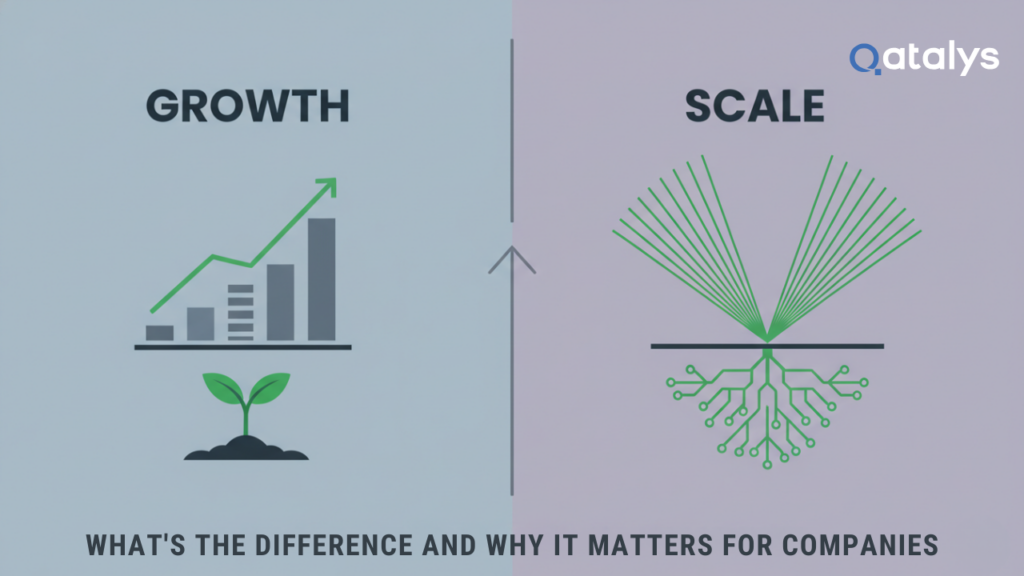
Growth Is Not Equal To Scale
Every startup wants growth. But not every startup is ready to scale. If you’re wondering how to scale a startup without breaking your team, product, or budget, the answer lies in building systems, not just chasing growth.
There’s a difference – and it matters.
Growth means getting more users, more revenue, more visibility. But scale? Scale is about doing all of that without breaking your team, tech, or budget.
A startup that grows by doubling its headcount or burning twice the capital isn’t really scaling – it’s expanding linearly. True scalability means building systems that deliver exponential output without matching increases in input.
And that’s the kind of foundation investors look for. It’s what keeps teams lean. And it’s how breakout startups actually become sustainable businesses.
In this guide, we’ll explore the core strategies early-stage founders can use to build scalable startups – across product, tech, growth, and operations. Let’s start by understanding what makes a startup scalable in the first place.
What is a Scalable Startup?
A scalable startup is designed to grow revenue and users without a proportional increase in cost, team size, or operational complexity. Instead of relying on manual effort, scalable startups use systems, automation, and repeatable processes to handle growth efficiently.
Key Pillars of a Scalable Startup
- Scalable tech architecture
- Focused product strategy
- Repeatable go-to-market systems
- Automated operations and workflows
What Makes a Startup Scalable? (Key Traits Explained)
Scalability isn’t just about growth – it’s about the quality of growth.
A scalable startup is built in a way that allows it to serve more customers, generate more revenue, and deliver more value without a corresponding spike in cost, headcount, or operational complexity.
Here are the traits that define scalable startups:
1. A Focused, Repeatable Problem-Solution Fit
Scalable startups solve problems that affect a large and clearly identifiable audience, are recurring or urgent enough to justify payment, and can be addressed through a standardized product or service (not custom work every time).
2. A Business Model That Supports Leverage
Scalable models include tech products (SaaS, platforms, APIs), digital delivery models (marketplaces, subscriptions), and usage-based pricing that grows with the customer. These allow startups to grow revenue without increasing marginal cost.
3. Systems That Handle Volume Gracefully
From CRM setups to product infrastructure, scalable startups invest early in tools and processes that automate repetitive work, deliver consistent experiences across user cohorts, and minimize the need for manual firefighting as demand increases.
4. A Culture That Supports Delegation and Documentation
Scalability isn’t just about code or revenue – it’s also about team dynamics. Startups that scale effectively build around documented processes, encourage cross-functional collaboration, and avoid bottlenecks caused by single-person dependency (especially founders). In short, scalability is built on systems, not effort.
Core Pillars of Scalable Startup Growth
To scale sustainably, startups need more than just ambition. They need a foundation built on systems that enable faster growth without collapsing under pressure. Let’s break this into four essential pillars:
1. Scalable Tech Architecture
You can’t scale what can’t support scale.
- Modular, API-First Design: Helps future-proof your product and enables integration with third-party tools as you grow.
- Cloud-Native Infrastructure: Using serverless, containerized environments ensures your backend can flex as demand spikes.
- CI/CD Pipelines: Accelerate deployment cycles with built-in testing and rollout automation, enabling continuous improvement.
- Avoiding Tech Debt: Don’t sacrifice long-term maintainability for short-term hacks. Scalable tech requires clean foundations.
At Qatalys Venture Studio, we build architecture from day one to handle future scale – without needing constant rework.
2. Product Strategy That Supports Scale
Scaling isn’t about adding more features – it’s about refining what matters most.
- Laser-Focus on One Problem: Avoid building a bloated product. Start with a sharp, validated use case.
- User Self-Service: Minimize dependency on your team by building intuitive UX, onboarding flows, and documentation.
- Feedback Loops: Collect data to iterate quickly and efficiently on what users actually want.
- Growth Loops: Build mechanics that compound usage – like referrals, network effects, or data-driven personalization.
3. Go-to-Market That Doesn’t Depend on Founder Hustle
Scalable growth means building a GTM system – not a founder-led hustle.
- Repeatable Sales Process: Define ICP, value proposition, and outreach sequences that can be handed off to others.
- Performance Marketing with Attribution: Use SEO, PPC, and paid social with full funnel tracking and ROI analysis.
- Automation in Outreach & Nurturing: Email workflows, retargeting, and CRM integrations let you scale customer acquisition.
- Partnerships & Channels: Tapping into existing communities or platforms can unlock new growth without reinventing the wheel.
4. Ops That Don’t Break Under Pressure
The best ops are invisible – and automated.
- Automated Billing & Onboarding: Stripe, Chargebee, and low-code tools can handle this without dev time.
- Standardized Support: Use chatbots, help centers, and tiered ticket systems to serve growing users without scaling headcount.
- No-Code Internal Workflows: Tools like Zapier, Make, and Airtable automate everything from reporting to task assignment.
- Team Enablement: Invest in process documentation, dashboards, and async culture to reduce reliance on constant communication.
Growth vs Scale (What Most Founders Get Wrong)
| Growth | Scale |
|---|---|
| More users, more revenue | More output without proportional input |
| Often increases cost | Keeps costs controlled |
| Can rely on effort | Relies on systems |
| Short-term wins | Long-term sustainability |
Common Mistakes That Prevent Startups from Scaling
Even well-funded, high-potential startups can stall when they confuse “fast growth” with “smart growth.” Here are the most common traps that derail scalability:
- Hiring Too Fast, Too Soon: Throwing bodies at problems creates bloated org charts and communication chaos. Scale should come from systems, not headcount. Hire to optimize – not to patch broken workflows.
- Overbuilding Before Product-Market Fit: Founders often rush to add features before validating the core use case. This leads to technical debt, distracted roadmaps, and complexity that’s hard to unwind later.
- Relying on the Founder for Everything: Sales, decisions, execution – if it all runs through one person, you’ve created a bottleneck. Scalability demands clear roles, documented processes, and the ability to delegate.
- No Data Strategy: Scaling without visibility into what’s working is like flying blind. Without proper analytics, startups waste time on channels, features, and audiences that don’t convert.
- Ignoring Internal Infrastructure: Failing to invest in ops (like onboarding, billing, and support) creates chaos when volume increases. The startup looks great externally but breaks internally – causing churn and burnout.
- Growing Without a Clear GTM Engine: Organic referrals and founder-led demos can get you early traction – but they don’t scale. Startups often delay setting up a repeatable GTM system until it’s too late.
How Qatalys Helps Startups Build Scalable Systems
Building scalable systems early is hard, especially when founders are balancing product, hiring, and growth at the same time. At Qatalys Venture Studio, scalability isn’t treated as a late-stage optimization – it’s baked into how we build from day one.
We work with early-stage founders who already have traction – whether that’s a validated MVP, early customers, or initial funding – and partner with them to engineer businesses that grow without growing pains.
Here’s how we help startups scale smart:
- Product & Tech Foundations That Scale: We build modular, cloud-native architectures with built-in devops, QA, and scalability in mind. From frontend UX to backend infrastructure, everything is designed to handle increased user volume and feature complexity without rework.
- Go-to-Market Systems That Don’t Rely on Guesswork: We help craft and execute data-backed GTM strategies using automation, performance marketing, CRM workflows, and channel plays.
- Operations That Run Smoothly as You Grow: From automated onboarding flows to internal dashboards and billing integrations, we build the ops layer startups often skip. This ensures your business doesn’t buckle under pressure when traction hits.
- Hands-On, Cross-Functional Partnership: We don’t just advise – we bring in execution-ready tech and growth teams who know how to build scalable systems. Think of us as a co-creator who’s invested in both your speed and your sustainability.
Our goal isn’t to help you just launch. It’s to help you grow with confidence – without chasing down every fire or rebuilding your stack six months in.
Scale Intentionally, Not Accidentally
Growth gets the headlines. But scalability builds companies that last.
Startups that scale well do so not because they hustle harder, but because they build systems – tech, product, GTM, and ops – that enable growth without friction. They don’t wait for things to break to start optimizing. They plan for volume, complexity, and success from the start.
If you’re building something meaningful and gaining early traction, now is the time to set the right foundations.
Partner with Qatalys Venture Studio
At Qatalys Venture Studio, we help funded and traction-stage founders scale fast – without scaling chaos.
From building scalable tech platforms to setting up GTM engines and operational systems, our cross-functional teams help you go from early traction to enterprise-grade growth.
Not Sure If Your Startup Is Ready to Scale?
If you’re building traction but unsure whether your product, tech, and GTM systems can handle growth, we can help you assess that.
We’ll look at:
- your current bottlenecks
- scalability gaps across product, tech, and ops
- what needs to be fixed before scaling
No pitch. Just clarity.
FAQs
1. What does it mean for a startup to be scalable?
A scalable startup can grow users and revenue without a proportional increase in costs, team size, or operational complexity. It relies on systems, automation, and repeatable processes rather than manual effort.
2. How do you scale a startup effectively?
Scaling a startup requires strong foundations in product, technology, go-to-market strategy, and operations. Founders should focus on building systems that support growth rather than relying on ad hoc efforts.
3. What are the key components of a scalable startup?
Key components include a scalable tech architecture, a focused product strategy, repeatable GTM processes, automated operations, and a data-driven decision-making approach.
4. When should a startup focus on scaling?
Startups should focus on scaling after achieving product-market fit and initial traction. Scaling too early can lead to wasted resources and operational inefficiencies.
5. What is the difference between growth and scalability?
Growth refers to increasing users or revenue, often with higher costs. Scalability means growing efficiently, where output increases without a matching rise in input or expenses.

Qatalys is a global AI-powered digital transformation company helping businesses drive innovation, scale operations, and achieve sustainable growth. With 30+ years of experience and 1,000+ projects delivered, Qatalys offers services including digital transformation, GCC setup, product engineering, growth services, cybersecurity, and QA. Serving industries like healthcare, BFSI, retail, and more, Qatalys combines global expertise with cost-efficient delivery from India.