Healthcare organizations rely on complex software platforms to manage clinical workflows, patient records, diagnostics, billing systems, and data analytics. These platforms must support thousands of daily transactions while ensuring high reliability, security, and compliance with healthcare regulations.
At the center of these platforms is a critical architectural decision: whether to build healthcare software using monolithic architectures or microservices architectures.
Historically, most Electronic Medical Record (EMR) systems and hospital information systems were developed using monolithic architectures. However, modern healthcare platforms increasingly adopt microservices architectures to support interoperability, scalability, and digital health innovation.
Understanding the strengths and limitations of both architectural models is essential when designing healthcare technology platforms.
Why Architecture Matters in Healthcare Platforms
Healthcare systems are among the most complex enterprise software environments.
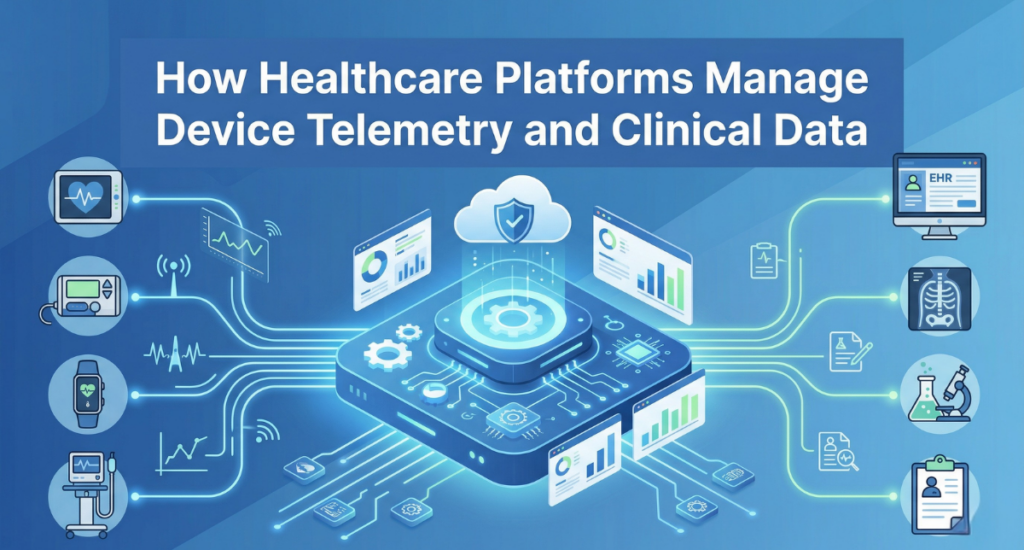
A typical healthcare platform must integrate with:
- Electronic Medical Record (EMR) systems
- laboratory information systems
- radiology and imaging platforms
- pharmacy networks
- patient engagement applications
- remote monitoring devices
- insurance and billing systems
These integrations generate continuous streams of clinical and operational data.
Software architecture determines how effectively a healthcare platform can manage these integrations, scale as patient volumes grow, and support new digital health capabilities.
Poor architectural decisions can lead to slow system performance, integration bottlenecks, and difficulties introducing new features.
What Is a Monolithic Architecture
A monolithic architecture is a traditional software design approach in which the entire application is built as a single, unified codebase. All system components – including user interfaces, business logic, and data access layers – are tightly integrated within a single application.
Many early healthcare platforms, including legacy EMR systems, were designed as monolithic applications. Typical modules within a monolithic healthcare system may include:
- patient registration and scheduling
- clinical documentation
- laboratory orders and results
- billing and revenue cycle management
- reporting and analytics
All these modules operate within the same application environment and typically share a single database. Because everything is tightly connected, changes to one component can affect the entire system.
Advantages of Monolithic Architectures in Healthcare
Despite the growing popularity of microservices, monolithic architectures still offer several advantages in healthcare environments.
- Simpler system design: Monolithic systems are easier to design and deploy because all application components operate within a single environment.
- Strong transactional consistency: Healthcare systems often require strict data consistency for clinical records and billing transactions. Monolithic architectures simplify transactional operations.
- Easier debugging and testing: Since the entire application runs as a single system, developers can more easily trace system behavior and identify issues.
- Lower operational complexity: Managing a single application requires less infrastructure compared to distributed microservices environments.
For smaller healthcare systems or early-stage digital health platforms, monolithic architectures can provide a practical starting point.
Limitations of Monolithic Healthcare Systems
As healthcare platforms grow more complex, monolithic architectures begin to reveal several limitations.
- Limited scalability: Scaling a monolithic system often requires scaling the entire application, even when only specific modules require additional resources.
- Slower development cycles: Because all components are tightly coupled, introducing new features can require extensive testing and system-wide updates.
- Difficult integrations: Modern healthcare platforms must integrate with numerous external systems. Monolithic architectures can make integration development slower and more rigid.
- Technical debt accumulation: Over time, large monolithic systems accumulate technical debt, making maintenance and modernization increasingly difficult.
These limitations are one of the main reasons healthcare organizations pursue platform modernization initiatives.
What Is Microservices Architecture
Microservices architecture takes a very different approach to software design. Instead of building a single application, the system is divided into independent services, each responsible for a specific business function.
Each microservice operates independently and communicates with other services through APIs or messaging systems. For example, a healthcare platform built using microservices might include separate services for:
- patient identity management
- appointment scheduling
- clinical documentation
- billing services
- analytics services
- notification and messaging services
Each service can be developed, deployed, and scaled independently. This modular approach allows healthcare platforms to evolve more quickly as requirements change.
Advantages of Microservices in Healthcare Platforms
Microservices architectures offer several advantages for modern healthcare platforms.
- Independent scalability: Different components of the healthcare platform can scale independently. For example, appointment scheduling services may require different scaling patterns than analytics systems.
- Faster feature development: Teams can develop and deploy new services without affecting other parts of the system, enabling faster innovation.
- Better integration capabilities: Microservices rely heavily on APIs, making it easier to connect healthcare platforms with external systems, digital health applications, and patient engagement tools.
- Modular architecture: Breaking the platform into smaller services allows healthcare organizations to replace or upgrade individual components without rebuilding the entire system.
These advantages are particularly valuable for healthcare organizations building modern digital health platforms.
Challenges of Microservices in Healthcare Systems
While microservices architectures offer flexibility, they also introduce new challenges.
- Distributed system complexity: Microservices architectures involve multiple independent services that must communicate reliably. Managing this distributed environment requires advanced infrastructure.
- Data consistency: Healthcare systems require accurate and consistent patient records. Ensuring data consistency across distributed services can be challenging.
- Operational overhead: Operating dozens or hundreds of microservices requires sophisticated infrastructure, including container orchestration, monitoring systems, and API management platforms.
- Security and compliance considerations: Healthcare platforms must protect sensitive patient data. Distributed systems increase the number of potential security points that must be managed carefully.
Because of these challenges, microservices adoption must be carefully planned in healthcare environments.
Hybrid Architectures in Healthcare Modernization
In practice, most healthcare organizations do not immediately replace monolithic systems with fully microservices-based architectures. Instead, they adopt hybrid architectures that gradually modernize legacy systems. A common approach is the strangler pattern, where new microservices are introduced around the existing monolithic system.
Over time, individual functions are migrated into microservices while the legacy system continues operating. Organizations also introduce API layers that allow modern applications to interact with existing systems. This incremental modernization approach reduces risk while allowing healthcare platforms to evolve toward more flexible architectures.
Qatalys Perspective: Architecting Modern Healthcare Platforms
At Qatalys, healthcare platform engineering has long involved modernizing complex clinical systems and designing integration architectures that support evolving healthcare ecosystems.
Our teams have worked with healthcare organizations to develop scalable platforms capable of supporting interoperability, device integrations, and modern analytics capabilities.
For example, Qatalys contributed to the development of the Aprima EMR and Practice Management platform, enabling physician practices to manage clinical documentation, scheduling, billing workflows, and diagnostic integrations within a unified system.
Across healthcare engagements, Qatalys engineers have delivered more than 3500 custom interfaces connecting EMR platforms with laboratory systems, imaging systems, pharmacy networks, and medical devices.
These experiences demonstrate that healthcare architecture decisions must balance scalability, reliability, interoperability, and regulatory compliance.
When Healthcare Platforms Should Use Microservices
Microservices architectures are particularly beneficial in healthcare environments that require high scalability and rapid innovation. Examples include:
- digital health platforms serving large patient populations
- healthcare SaaS platforms supporting multiple providers
- remote patient monitoring systems
- healthcare analytics platforms processing large datasets
In these environments, modular microservices architectures allow organizations to scale specific services and deploy new capabilities quickly.
Microservices vs Monolithic Architectures in Healthcare Software
Both monolithic and microservices architectures play important roles in healthcare software development. Monolithic architectures offer simplicity and strong data consistency, which can be valuable in many clinical environments.
However, as healthcare systems grow more complex and interconnected, microservices architectures provide the flexibility and scalability needed to support modern digital health platforms.
Most healthcare organizations ultimately adopt hybrid approaches that combine the reliability of legacy systems with the scalability of microservices-based architectures. Making the right architectural decision requires careful evaluation of system requirements, integration complexity, and long-term platform goals.
FAQs
1. What is the difference between monolithic and microservices architecture?
Monolithic architectures build applications as a single unified system, while microservices architectures divide applications into independent services that communicate through APIs.
2. Are EMR systems typically monolithic?
Many legacy EMR systems were originally designed as monolithic applications, although modern healthcare platforms increasingly adopt modular architectures.
3. Why are healthcare platforms adopting microservices?
Microservices allow healthcare platforms to scale more easily, support faster development cycles, and integrate with external healthcare systems more effectively.
4. What challenges do microservices introduce in healthcare systems?
Microservices introduce distributed system complexity, operational overhead, and data consistency challenges that must be carefully managed.
5. Can healthcare platforms combine monolithic and microservices architectures?
Yes. Many healthcare organizations adopt hybrid architectures that gradually introduce microservices while maintaining existing monolithic systems.

Qatalys is a global AI-powered digital transformation company helping businesses drive innovation, scale operations, and achieve sustainable growth. With 30+ years of experience and 1,000+ projects delivered, Qatalys offers services including digital transformation, GCC setup, product engineering, growth services, cybersecurity, and QA. Serving industries like healthcare, BFSI, retail, and more, Qatalys combines global expertise with cost-efficient delivery from India.