Modern hospitals operate within complex digital ecosystems that involve dozens of specialized healthcare systems. At the center of this ecosystem is the Electronic Medical Record (EMR) platform, which stores patient information, clinical documentation, and operational data. However, the EMR alone does not run the hospital.
Laboratories rely on Laboratory Information Systems (LIS), radiology departments operate Radiology Information Systems (RIS), and imaging platforms such as PACS, while financial operations depend on billing and revenue cycle management systems.
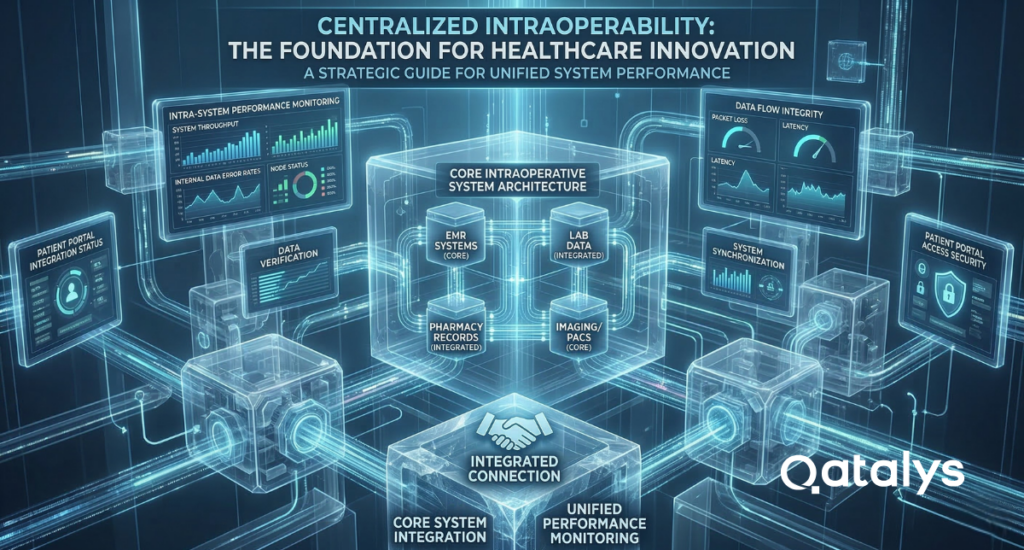
For hospital operations to function efficiently, these systems must exchange information continuously. This is achieved through healthcare interoperability – the integration of EMR platforms with clinical, diagnostic, and administrative systems. Without integration, each department becomes a data silo. With integration, hospitals create unified digital environments that support coordinated care, efficient workflows, and accurate billing.
Core Systems in a Hospital IT Environment
Hospitals typically operate multiple specialized healthcare systems that support different clinical and administrative functions.
1. Electronic Medical Records (EMR / EHR)
The EMR is the central clinical platform used by physicians and care teams. It manages patient records, clinical documentation, medication orders, and care coordination. Because the EMR acts as the system of record for patient information, most other hospital systems exchange data with it.
2. Laboratory Information Systems (LIS)
Laboratory Information Systems manage diagnostic testing workflows. These systems handle lab orders, specimen tracking, test processing, and result reporting. Integration between LIS and EMR systems allows physicians to order tests and receive results directly within clinical workflows.
3. Radiology Information Systems (RIS)
Radiology Information Systems manage imaging orders, scheduling, and reporting for diagnostic imaging departments. RIS platforms coordinate workflows for radiologists, imaging technicians, and referring physicians.
4. PACS (Picture Archiving and Communication Systems)
PACS systems store and manage medical images generated by imaging modalities such as CT scans, MRI scans, and X-rays. Integration with EMR platforms allows clinicians to view imaging results alongside patient records.
5. Billing and Revenue Cycle Systems
Hospital billing systems manage claims processing, insurance verification, coding workflows, and financial reporting. These systems must integrate with clinical platforms to capture patient encounters, procedures, and diagnoses required for reimbursement.
Why Integration Is Critical for Hospitals
Healthcare integration is essential for both clinical and operational efficiency.
1. Coordinated clinical workflows
When systems are integrated, physicians can access lab results, imaging reports, and medication information directly within the EMR. This eliminates the need to switch between systems or manually retrieve information from different departments.
2. Faster diagnoses
Integrated diagnostic workflows allow lab results and imaging reports to be delivered to clinicians in near real time. This improves decision-making speed and supports more responsive patient care.
3. Reduced manual data entry
Integration eliminates redundant data entry across multiple systems, reducing administrative workload and minimizing the risk of data errors.
4. Accurate billing and claims processing
Billing systems rely on clinical documentation to generate claims and reimbursement records. Integration ensures that procedures, diagnoses, and services are captured accurately.
How Healthcare Data Moves Between Hospital Systems
Hospital integration relies on structured data exchange between systems.
For example, when a patient is admitted to a hospital, the EMR generates an ADT message (Admission, Discharge, Transfer) that notifies other systems within the hospital environment. These messages update patient information across platforms such as:
- laboratory systems
- imaging systems
- pharmacy platforms
- billing systems
Similarly, when a physician orders a lab test, the EMR sends an ORM message (Order Message) to the laboratory system. Once the test is completed, the LIS sends an ORU message (Observation Result) containing the lab results back to the EMR. This continuous exchange of clinical information allows hospital systems to remain synchronized.
Integration Standards Used in Hospitals
Healthcare systems rely on several interoperability standards to exchange data reliably.
1. HL7
HL7 (Health Level Seven) is one of the most widely used messaging standards in healthcare. It defines structured message formats that allow clinical systems to exchange information such as patient admissions, lab orders, and test results. HL7 messaging remains the backbone of many hospital integration architectures.
2. FHIR
FHIR (Fast Healthcare Interoperability Resources) is a modern interoperability standard that uses web-based APIs. FHIR allows healthcare applications to exchange data using REST APIs and formats such as JSON and XML. Many modern healthcare platforms are adopting FHIR to support cloud-based healthcare applications and patient-facing digital services.
3. DICOM
DICOM (Digital Imaging and Communications in Medicine) is the standard used for medical imaging. It enables imaging equipment and PACS systems to store, retrieve, and exchange diagnostic images.
4. X12
X12 standards are used for healthcare financial transactions such as insurance claims, payment processing, and eligibility verification.
Integration Architecture in Hospitals
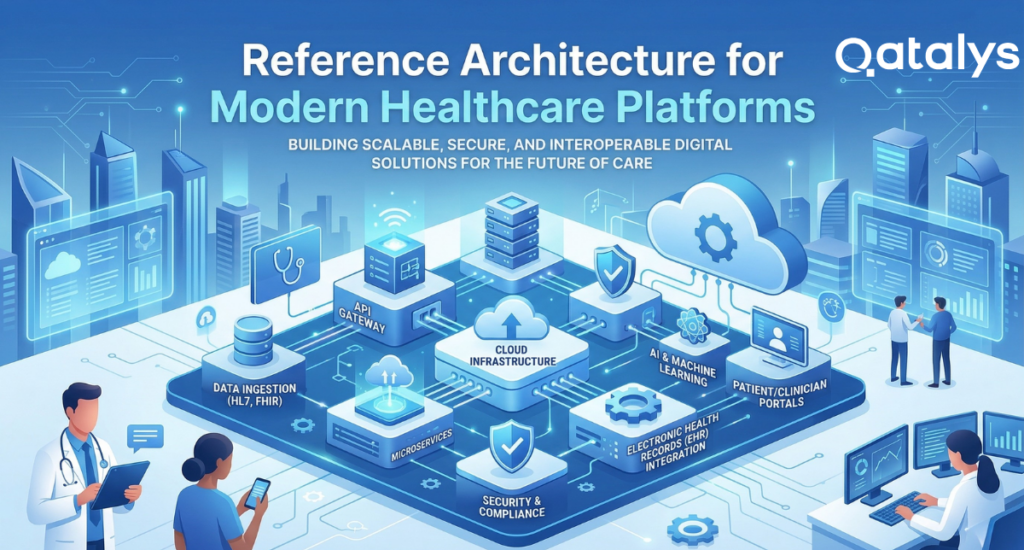
Behind every integrated hospital system is an interoperability architecture that manages data exchange across platforms. Most hospitals rely on an integration engine or middleware platform that sits between systems.
This architecture typically includes:
- Source systems such as EMR platforms, lab systems, and imaging platforms
- Integration engine responsible for routing messages between systems
- Message transformation layers that map data formats between systems
- Workflow orchestration components that manage data routing logic
- Destination systems, such as billing platforms or analytics systems
Integration engines also provide monitoring capabilities that track message flow and detect errors in data exchange. This architecture allows hospitals to maintain hundreds of system interfaces while ensuring reliable communication between platforms.
Real Integration Scenarios in Hospitals
Healthcare interoperability supports several operational workflows within hospitals.
- Laboratory integration: When a physician orders a lab test in the EMR, the order is transmitted to the laboratory system. Once testing is complete, results are automatically sent back to the EMR and displayed in the patient record.
- Radiology integration: Imaging orders created in the EMR are routed to the radiology system, which schedules and processes the imaging study. Images are stored in PACS and linked to the patient’s record for physician review.
- Medical device integration: Many hospitals integrate medical devices such as cardiac monitoring systems, infusion pumps, and diagnostic equipment with clinical platforms. Device telemetry data can be transmitted directly into patient records.
- Billing and claims integration: Clinical encounters documented in the EMR are transmitted to revenue cycle management systems for coding, claims submission, and reimbursement.
Integration Challenges in Hospital Systems
Despite its importance, healthcare integration remains complex.
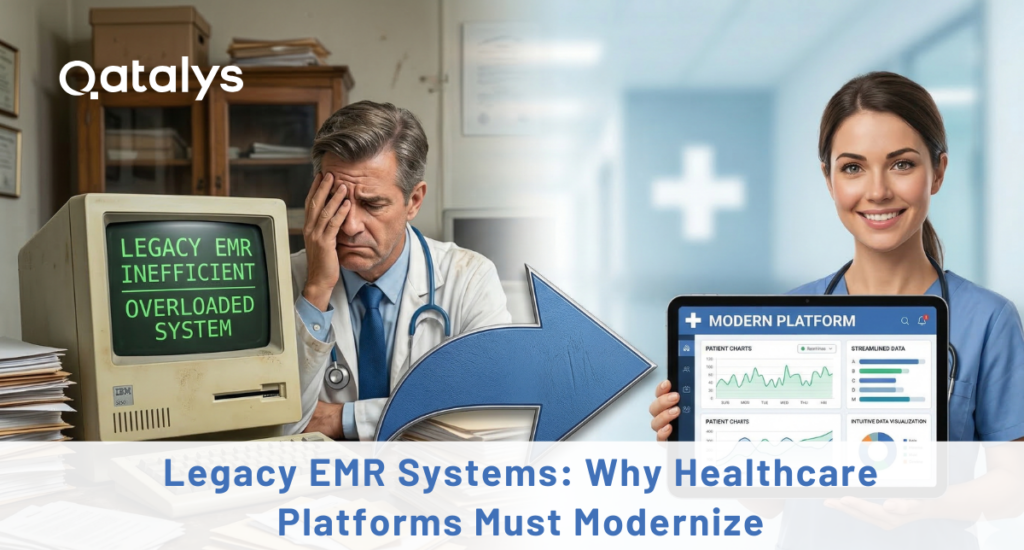
- Legacy systems: Many hospitals still operate older healthcare platforms that were not designed for modern interoperability. These systems may rely on outdated integration frameworks or proprietary interfaces.
- Data mapping complexity: Different systems often represent clinical data in different formats. Integration platforms must transform and normalize this data before it can be used by other systems.
- Interface management: Large healthcare organizations may operate hundreds of system interfaces, each requiring monitoring and maintenance.
- Regulatory compliance: Healthcare data exchange must comply with strict privacy and security regulations such as HIPAA. Integration platforms must ensure that patient data remains secure during transmission.
Qatalys Perspective: Integrating Complex Healthcare Systems
Healthcare integration has been a core engineering capability at Qatalys for more than two decades. Our teams have supported large-scale healthcare platforms by building integrations across clinical, diagnostic, and administrative systems.
Across multiple healthcare engagements, Qatalys engineers have delivered over 3500 custom interfaces connecting EMR platforms with laboratory systems, imaging systems, pharmacy networks, and medical devices.
For example, Qatalys contributed to the development and integration architecture of the Aprima EMR and Practice Management platform, supporting physician practices with clinical documentation, lab integrations, and billing workflows.
Our teams have also developed healthcare integration components across platforms used by organizations such as Allscripts, CVS Caremark, Ramsoft, and Intersystems, enabling real-time clinical data exchange across healthcare ecosystems.
These experiences highlight an important reality: hospital integration is not simply a technical task. It requires deep understanding of healthcare workflows, interoperability standards, and scalable integration architectures.
The Future of Hospital Integration
Healthcare IT is moving toward increasingly connected digital environments. Hospitals are adopting platforms that are:
- API-first
- cloud-enabled
- interoperable
- data-driven
Modern interoperability frameworks such as FHIR and cloud-based integration engines are enabling hospitals to connect clinical systems, analytics platforms, and digital health applications more efficiently. As healthcare continues to evolve toward integrated care delivery models, interoperability will remain a foundational component of hospital IT infrastructure.
Wrapping Up: Healthcare Integration
Hospitals depend on a complex network of clinical, diagnostic, and administrative systems to deliver patient care.
Integrating EMR platforms with laboratory systems, imaging platforms, and billing systems allows hospitals to operate as unified digital environments rather than disconnected silos. This integration improves clinical workflows, supports faster diagnoses, and enables accurate billing and reporting.
For healthcare organizations navigating digital transformation, building reliable interoperability architectures is essential for delivering efficient and data-driven healthcare.
FAQs
1. What is EMR integration in healthcare?
EMR integration refers to connecting electronic medical record systems with other healthcare platforms such as laboratory systems, imaging platforms, and billing systems to enable seamless data exchange.
2. How do laboratory systems connect to EMR platforms?
Laboratory systems typically integrate with EMR platforms using HL7 messaging standards that transmit lab orders and results between systems.
3. What standards are used for healthcare integration?
Common standards include HL7 for clinical messaging, FHIR for API-based data exchange, DICOM for imaging systems, and X12 for financial transactions.
4. What is a healthcare integration engine?
An integration engine is middleware that routes, transforms, and monitors data exchange between healthcare systems.
5. Why is interoperability important for hospitals?
Interoperability enables healthcare systems to share data efficiently, improving clinical workflows, care coordination, and operational efficiency.

Qatalys is a global AI-powered digital transformation company helping businesses drive innovation, scale operations, and achieve sustainable growth. With 30+ years of experience and 1,000+ projects delivered, Qatalys offers services including digital transformation, GCC setup, product engineering, growth services, cybersecurity, and QA. Serving industries like healthcare, BFSI, retail, and more, Qatalys combines global expertise with cost-efficient delivery from India.