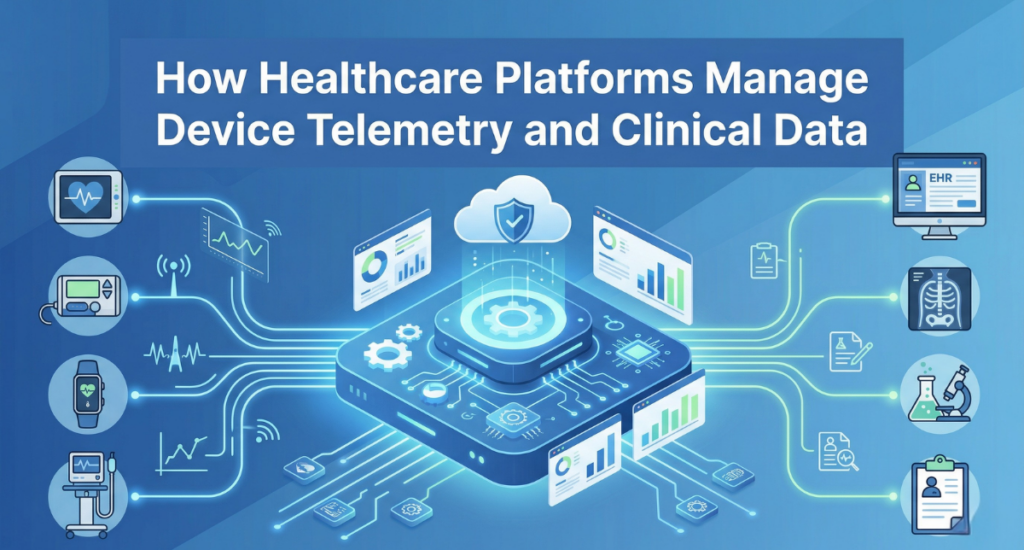
Healthcare systems today generate vast amounts of clinical, diagnostic, and operational data. Hospitals rely on Electronic Medical Records (EMR), laboratory systems, imaging platforms, patient engagement tools, and analytics platforms to manage patient care.
Yet technology alone does not automatically improve healthcare outcomes.
The real impact comes from connected healthcare platforms that allow clinicians to access the right information at the right time. When clinical data flows seamlessly across systems, physicians can make faster diagnoses, coordinate care more effectively, and monitor patient health continuously.
Modern healthcare technology platforms therefore, play a central role in improving patient outcomes by enabling data-driven care delivery.
The Shift Toward Platform-Driven Healthcare
Healthcare organizations historically implemented technology systems independently.
Hospitals deployed:
- EMR systems for patient records
- Laboratory systems for diagnostics
- radiology platforms for imaging
- billing systems for financial workflows
These systems often operated in isolation, creating fragmented data environments.
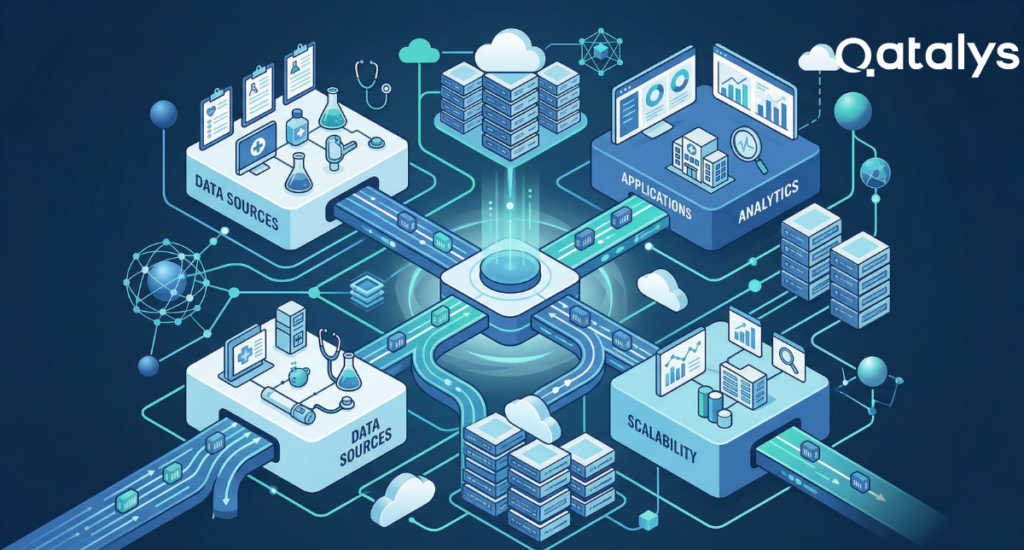
Today, healthcare organizations are moving toward integrated digital platforms that connect these systems into unified care environments. Instead of functioning as separate tools, clinical systems operate within a coordinated technology ecosystem.
This shift toward platform-based healthcare enables clinicians to view a patient’s complete medical history, diagnostic results, and treatment plans in a single environment.
What We Mean by Healthcare Technology Platforms
A healthcare technology platform refers to the integrated infrastructure that connects clinical systems, diagnostic tools, and data services across the healthcare ecosystem. These platforms typically include:
- Electronic Medical Record (EMR / EHR) systems
- Laboratory Information Systems (LIS)
- Radiology Information Systems (RIS) and imaging platforms
- patient portals and engagement tools
- analytics and reporting platforms
- interoperability and integration systems
Rather than operating independently, these systems exchange information through interoperability frameworks such as HL7 messaging and FHIR APIs. The result is a digital platform that supports clinical workflows across the entire care delivery process.
1. Better Clinical Decisions Through Unified Patient Data
One of the most important benefits of healthcare platforms is the ability to consolidate patient information across systems. Physicians must often make critical decisions quickly. Having access to a complete patient record significantly improves the quality of those decisions. When healthcare systems are integrated, clinicians can view:
- medical history
- laboratory results
- imaging reports
- medication records
- previous diagnoses
in a single clinical interface.
Without these integrated platforms, physicians may need to retrieve information from multiple systems, increasing the risk of delays or incomplete data. Unified patient records allow clinicians to make more informed decisions, which directly contribute to improved patient outcomes.
2. Faster Diagnosis Through Integrated Clinical Systems
Timely diagnosis is critical in healthcare, particularly in emergency medicine and complex disease management. Technology platforms improve diagnostic speed by connecting diagnostic systems directly with clinical platforms.
For example, when a physician orders a laboratory test within an EMR system, the request is transmitted electronically to the laboratory information system. Once the test is completed, results are automatically returned to the patient’s medical record.
Similarly, radiology systems integrate with imaging platforms that store diagnostic images. Physicians can review imaging studies directly within the patient record.
By eliminating manual communication and fragmented systems, integrated platforms reduce delays in diagnostic workflows and allow clinicians to act more quickly.
3. Continuous Monitoring and Preventive Care
Healthcare technology platforms are increasingly extending care beyond hospital walls. Remote monitoring technologies and connected medical devices allow healthcare providers to track patient health in real time. Examples include:
- wearable cardiac monitoring devices
- glucose monitoring systems for diabetes management
- remote blood pressure monitoring
These devices transmit health data to digital platforms where clinicians can analyze trends and detect potential health risks. Early detection enables healthcare providers to intervene before conditions worsen, improving long-term patient outcomes.
4. Data Analytics and AI in Healthcare Decision Support
Modern healthcare platforms increasingly incorporate analytics and artificial intelligence capabilities. These systems analyze large volumes of clinical data to identify patterns that support clinical decision-making. Examples include:
- predictive models identifying patients at risk of complications
- AI-assisted radiology analysis for detecting abnormalities in medical imaging
- population health analytics that identify trends across patient groups
By combining clinical data with advanced analytics, healthcare organizations can move toward more proactive and personalized care strategies. These capabilities help clinicians detect conditions earlier and tailor treatment plans to individual patients.
5. Improving Care Coordination Across Providers
Many patients receive care from multiple providers, including primary care physicians, specialists, diagnostic labs, and hospitals. Without technology platforms that enable data sharing, coordinating care across providers can be difficult. Healthcare interoperability frameworks allow patient information to move securely across systems and organizations.
When systems are interoperable, healthcare providers can share:
- diagnostic results
- treatment plans
- medication histories
- clinical observations
This continuity of information ensures that each provider has the context needed to deliver effective care. Care coordination is particularly important for patients managing chronic conditions that require long-term treatment across multiple providers.
6. Enhancing Patient Engagement and Adherence
Technology platforms also support patient engagement tools that encourage patients to take a more active role in their healthcare. Examples include:
- patient portals for accessing medical records
- digital appointment scheduling
- medication reminders
- educational resources
These tools help patients stay informed about their health and adhere to treatment plans. Higher patient engagement often leads to improved medication adherence, more consistent follow-up care, and better long-term outcomes.
Interoperability: The Foundation of Outcome-Driven Healthcare
One of the most important components of healthcare technology platforms is interoperability. Healthcare systems must exchange data reliably across clinical environments. Interoperability standards such as HL7, FHIR, and DICOM enable systems to communicate across organizations and platforms.
Through interoperability, healthcare providers can access patient data regardless of where care was delivered. This continuity of information is critical for preventing duplicate testing, avoiding medication conflicts, and maintaining accurate patient histories. In many ways, interoperability forms the backbone of modern healthcare technology platforms.
Qatalys Perspective: Building Healthcare Technology Platforms
At Qatalys, healthcare technology platform engineering has been a core capability for more than two decades.
Our teams have helped healthcare organizations build and modernize digital platforms that support clinical workflows, interoperability, and large-scale data exchange.
Across multiple healthcare engagements, Qatalys engineers have delivered more than 3500 custom interfaces connecting EMR systems with laboratory platforms, imaging systems, medical devices, and pharmacy networks.
For example, Qatalys contributed to the development of the Aprima EMR and Practice Management platform, which integrates clinical documentation, scheduling, billing workflows, and diagnostic systems for physician practices.
In addition, Qatalys has developed healthcare interoperability solutions that allow clinical data to flow securely across complex healthcare ecosystems.
These capabilities enable healthcare organizations to create integrated technology environments that support efficient clinical workflows and data-driven care delivery.
The Future of Outcome-Driven Healthcare Platforms
Healthcare technology continues to evolve rapidly as digital transformation reshapes care delivery. Several trends are shaping the next generation of healthcare platforms:
- cloud-based healthcare infrastructure
- real-time data exchange through API-driven interoperability
- AI-powered clinical decision support
- remote patient monitoring and digital therapeutics
- personalized medicine based on data analytics
These innovations will allow healthcare organizations to move beyond reactive care toward more proactive and preventive healthcare models.
As technology platforms continue to evolve, their ability to integrate clinical data, support decision-making, and coordinate care will play a central role in improving patient outcomes.
Conclusion
Healthcare technology platforms have become essential infrastructure for modern care delivery.
By integrating clinical systems, diagnostic platforms, patient engagement tools, and analytics capabilities, these platforms enable healthcare providers to access comprehensive patient data and coordinate care more effectively.
The result is faster diagnoses, improved care coordination, better patient engagement, and ultimately stronger patient outcomes.
For healthcare organizations navigating digital transformation, investing in connected healthcare platforms is not simply a technology upgrade – it is a strategic step toward delivering more effective, data-driven healthcare.
FAQs
1. How does healthcare technology improve patient outcomes?
Healthcare technology improves outcomes by enabling faster diagnoses, better care coordination, real-time patient monitoring, and data-driven clinical decision-making.
2. What are healthcare technology platforms?
Healthcare technology platforms are integrated systems that connect clinical applications such as EMR systems, laboratory platforms, imaging systems, and analytics tools.
3. What role does interoperability play in patient outcomes?
Interoperability allows healthcare systems to exchange patient data across providers, ensuring that clinicians have access to complete medical histories when making treatment decisions.
4. How do analytics and AI improve healthcare outcomes?
Analytics and AI help clinicians identify risk patterns, detect diseases earlier, and personalize treatment strategies based on patient data.
5. Why are integrated healthcare platforms important?
Integrated platforms reduce data silos, improve clinical workflows, and allow healthcare providers to deliver coordinated care across multiple systems and organizations.
Qatalys is a global AI-powered digital transformation company helping businesses drive innovation, scale operations, and achieve sustainable growth. With 30+ years of experience and 1,000+ projects delivered, Qatalys offers services including digital transformation, GCC setup, product engineering, growth services, cybersecurity, and QA. Serving industries like healthcare, BFSI, retail, and more, Qatalys combines global expertise with cost-efficient delivery from India.