Healthcare systems are increasingly driven by connected medical devices that continuously monitor patient health. From intensive care units to remote patient monitoring programs, medical devices generate large volumes of real-time telemetry data.
Devices such as cardiac monitors, infusion pumps, ventilators, wearable sensors, and glucose monitoring systems continuously transmit physiological signals that clinicians rely on to monitor patient conditions. Managing this data effectively requires sophisticated healthcare technology platforms capable of ingesting, processing, and integrating telemetry data into clinical workflows.
Modern healthcare platforms therefore, play a critical role in transforming raw device signals into actionable clinical insights.
The Growing Role of Connected Medical Devices in Healthcare
Healthcare environments today include a wide range of connected medical devices that generate continuous streams of clinical data. Examples include:
- cardiac telemetry monitors
- bedside patient monitoring systems
- infusion pumps and ventilators
- wearable heart rhythm monitors
- glucose monitoring devices
- remote patient monitoring sensors
These devices collect physiological signals such as heart rate, blood pressure, oxygen saturation, respiratory rate, and glucose levels. In critical care environments, clinicians rely on these signals to track patient conditions in real time.
As healthcare delivery increasingly expands beyond hospitals into home-based care and remote monitoring programs, the number of connected devices generating telemetry data continues to grow. Managing this growing volume of device-generated data requires scalable healthcare platform architectures.
What Is Medical Device Telemetry
Telemetry refers to the remote collection and transmission of physiological data from medical devices to monitoring systems. In healthcare environments, telemetry enables clinicians to monitor patient health continuously without requiring manual data collection.
For example, cardiac telemetry systems track heart rhythm signals and transmit them to monitoring stations where clinicians can detect arrhythmias or abnormal heart activity.
Similarly, remote patient monitoring systems allow healthcare providers to track chronic disease indicators such as blood pressure or glucose levels while patients remain at home. Telemetry technologies therefore allow healthcare providers to move toward more proactive and continuous patient care models.
Types of Telemetry Data in Healthcare Systems
Medical devices generate several types of telemetry signals that healthcare platforms must process and interpret. Common telemetry data includes:
- Cardiac monitoring signals: Electrocardiogram (ECG) signals track heart rhythms and detect abnormalities such as arrhythmias or cardiac events.
- Vital sign monitoring: Devices measure physiological indicators such as heart rate, blood pressure, oxygen saturation, and respiratory rate.
- Glucose monitoring data: Continuous glucose monitoring devices transmit real-time blood glucose readings for patients managing diabetes.
- Activity and behavioral data: Wearable devices track activity levels, sleep patterns, and movement, providing additional health insights.
- Medical device operational data: Devices such as infusion pumps or ventilators also transmit operational status data to ensure proper functioning.
Together, these signals create a continuous stream of clinical telemetry data that healthcare platforms must process and integrate.
Device Connectivity and Data Transmission
Medical devices connect to healthcare platforms through a variety of communication technologies. In hospital environments, patient monitoring devices typically connect through secure hospital telemetry networks or wired connections. Remote monitoring devices may transmit data using:
- Bluetooth connections to mobile devices
- Wi-Fi networks
- cellular connectivity
- specialized medical telemetry networks
Many healthcare platforms use device gateways or edge systems that aggregate device data before transmitting it to centralized platforms. These gateways help normalize device communications and ensure reliable data transmission across the healthcare infrastructure.
Healthcare Telemetry Data Architecture
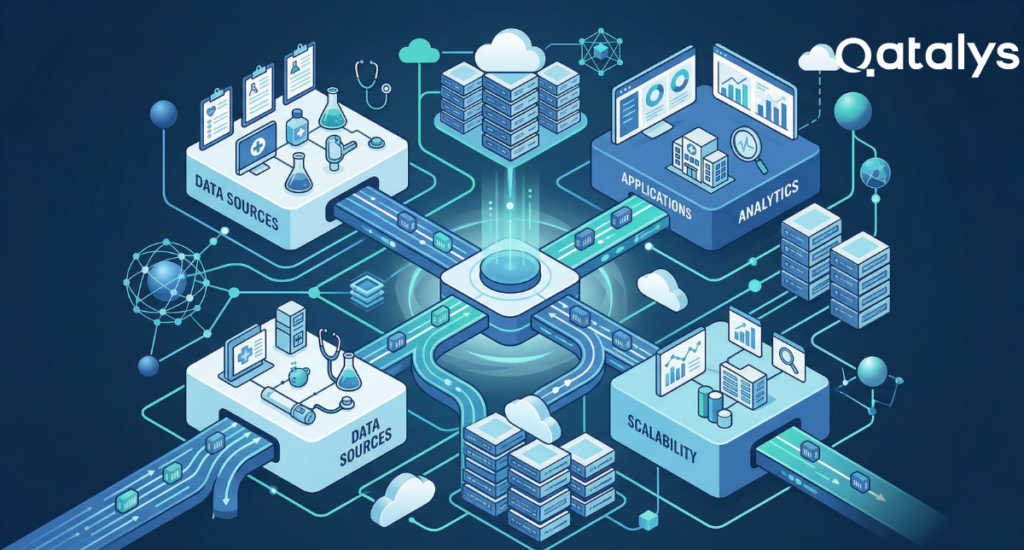
Behind every medical telemetry system is a complex technology architecture responsible for ingesting, processing, and distributing device data. A typical healthcare telemetry architecture includes several layers.
- Device layer: This layer includes patient monitoring devices, wearable sensors, and other clinical equipment that generate physiological signals.
- Gateway or edge layer: Gateways aggregate data from multiple devices and prepare it for transmission to centralized systems. They may perform functions such as data buffering, device authentication, and signal preprocessing.
- Telemetry platform: The telemetry platform receives data streams from device gateways and processes them in real time. These platforms often include capabilities such as signal analysis, anomaly detection, and alert generation.
- Integration layer: Integration engines or interoperability platforms route telemetry data to clinical systems such as EMR platforms.
- Clinical applications: Finally, telemetry data becomes available within clinical systems where physicians and nurses can monitor patient conditions and review historical data.
This architecture enables healthcare organizations to manage large volumes of device data while ensuring reliable clinical monitoring.
Real-Time Data Processing and Clinical Alerts
One of the most important functions of telemetry platforms is real-time data processing. Healthcare platforms continuously analyze telemetry signals to detect abnormal conditions that require clinical attention. Examples include:
- detecting irregular heart rhythms
- identifying sudden drops in oxygen saturation
- recognizing abnormal blood pressure readings
When these conditions occur, the platform can trigger alerts for clinicians. Low-latency processing is critical in these scenarios because timely alerts allow healthcare providers to intervene quickly and prevent complications. Advanced telemetry platforms also apply analytics and machine learning models to identify patterns in physiological data that may indicate emerging health risks.
Integrating Telemetry Data with EMR Systems
Telemetry signals are most valuable when integrated into the patient’s medical record. Healthcare platforms therefore link telemetry data with EMR systems so that clinicians can view device-generated data alongside other clinical information.
Integration requires several technical capabilities.
- Patient identity matching: Device telemetry must be associated with the correct patient record. Healthcare platforms use patient identifiers and device registration systems to ensure accurate mapping.
- Data normalization: Different medical devices produce data in various formats. Telemetry platforms normalize this data to ensure consistent interpretation.
- Interoperability standards: Healthcare systems often use interoperability frameworks such as HL7 messaging or FHIR APIs to transmit telemetry data to EMR systems. Once integrated into the patient record, telemetry data becomes part of the clinical decision-making process.
- Data Security and Compliance: Medical telemetry systems handle highly sensitive patient health data, making security and compliance critical components of platform architecture.
Healthcare platforms managing telemetry data must implement security measures such as:
- device authentication to prevent unauthorized devices from transmitting data
- encryption of data during transmission and storage
- access control mechanisms for clinical systems
- audit logging to track system activity
These measures help ensure compliance with healthcare regulations such as HIPAA while protecting patient privacy. Security is particularly important in environments where remote monitoring devices transmit data across public networks.
Qatalys Perspective: Building Telemetry-Ready Healthcare Platforms
At Qatalys, healthcare platform engineering has long included integration with medical devices and telemetry systems.
Our teams have designed and implemented integration architectures that connect clinical platforms with diagnostic equipment, monitoring systems, and external healthcare applications.
Across multiple healthcare engagements, Qatalys engineers have delivered over 3500 custom interfaces connecting EMR platforms with laboratory systems, imaging systems, pharmacy networks, and medical devices.
For example, Qatalys contributed to the development of the Aprima EMR and Practice Management platform, integrating clinical documentation, diagnostics, and operational workflows within a unified healthcare environment.
In addition, Qatalys developed the QIntegration Engine (QIE), an interoperability platform designed to manage healthcare messaging standards and enable reliable data exchange across complex healthcare ecosystems.
These experiences demonstrate how healthcare platforms must combine interoperability frameworks, device integrations, and scalable data pipelines to support modern telemetry-driven care environments.
The Future of Connected Healthcare Monitoring
Healthcare telemetry is evolving rapidly as connected devices become more advanced and widely adopted. Several trends are shaping the future of device-enabled healthcare platforms.
- Expansion of remote patient monitoring: Healthcare providers increasingly monitor chronic conditions through home-based monitoring systems.
- AI-driven signal analysis: Artificial intelligence systems can analyze physiological signals to identify subtle patterns that may indicate emerging health risks.
- IoT-based healthcare ecosystems: Hospitals are integrating thousands of connected devices into unified monitoring platforms.
- Predictive healthcare platforms: Telemetry data combined with analytics allows healthcare providers to anticipate complications before they occur.
These innovations will further expand the role of device telemetry in healthcare delivery.
Wrapping Up
Connected medical devices are transforming healthcare by enabling continuous monitoring of patient health. However, the value of these devices depends on healthcare platforms capable of managing large volumes of telemetry data and integrating it into clinical workflows.
By combining device connectivity, real-time data processing, interoperability frameworks, and secure platform architectures, healthcare organizations can turn telemetry signals into actionable clinical insights.
As healthcare continues to adopt connected technologies, scalable telemetry platforms will become essential infrastructure for modern digital health systems.
FAQs
1. What is medical telemetry in healthcare?
Medical telemetry refers to the remote monitoring and transmission of physiological data from medical devices to healthcare monitoring systems.
2. How do hospitals monitor telemetry data?
Hospitals use patient monitoring systems that collect device data, process it in telemetry platforms, and display it within clinical monitoring applications.
3. How is telemetry data integrated into EMR systems?
Telemetry platforms transmit device data to EMR systems using interoperability standards such as HL7 messaging or FHIR APIs.
4. What technologies enable remote patient monitoring?
Remote monitoring devices use technologies such as Bluetooth, Wi-Fi, and cellular connectivity to transmit health data to digital health platforms.
5. Why is telemetry important in healthcare?
Telemetry enables continuous monitoring of patient health, allowing clinicians to detect changes in patient conditions quickly and intervene when necessary.

Qatalys is a global AI-powered digital transformation company helping businesses drive innovation, scale operations, and achieve sustainable growth. With 30+ years of experience and 1,000+ projects delivered, Qatalys offers services including digital transformation, GCC setup, product engineering, growth services, cybersecurity, and QA. Serving industries like healthcare, BFSI, retail, and more, Qatalys combines global expertise with cost-efficient delivery from India.